The Memory Palace: Archives
A downloadable game
The Memory Palace Archives
An educational solo and group play one-page RPG meant for digital journaling, memory management, and memory retrieval
This game is free to download and use, but there are multiple versions (light and dark mode), expansions, and a web interactive version available, that you will have access to if you choose to make the recommended donation ($4.00 purchase) for the full versions of the game with updates for life.
Not only will you have access to the static / offline PDFs and high-res scans for poster printing, you will have access to the interactive PDF forms that are downloadable and usable offline via a device, and access to the web interactive games with enhanced experience like die rolling mechanics.
The game is meant to be printed double-sided on a single letter-sized sheet of paper, or scaled up accordingly to poster sizes (high-resolution exports are downloadable).
Table of Contents
- Summary
- Scientific Foundation
- Core Mechanics & Psychology
- Neuroscience of Memory Palaces
- Behavioral Design Principles
- Play Guidelines
- Designer's Notes
- Technical Specifications
- The Metacognitive Layer
- Future Research Directions
- Conclusion
- References
- Copyright
Summary ↑
The Memory Palace Archives is a narrative, card-based RPG that transforms the ancient method of loci into a collaborative story engine. Players become Librarians of the Mind, exploring impossible architectures where memories manifest as rooms and knowledge becomes sentient.
Why build this game now? To counter information overload and digital amnesia with play that:
- Leverages spatial memory, the brain's most powerful memory system
- Creates transactive memory across players
- Uses variable-ratio reinforcement to sustain engagement
- Induces flow via balanced challenge (skill tuning)
- Harnesses the Zeigarnik effect to drive completion motivation
Core Loop
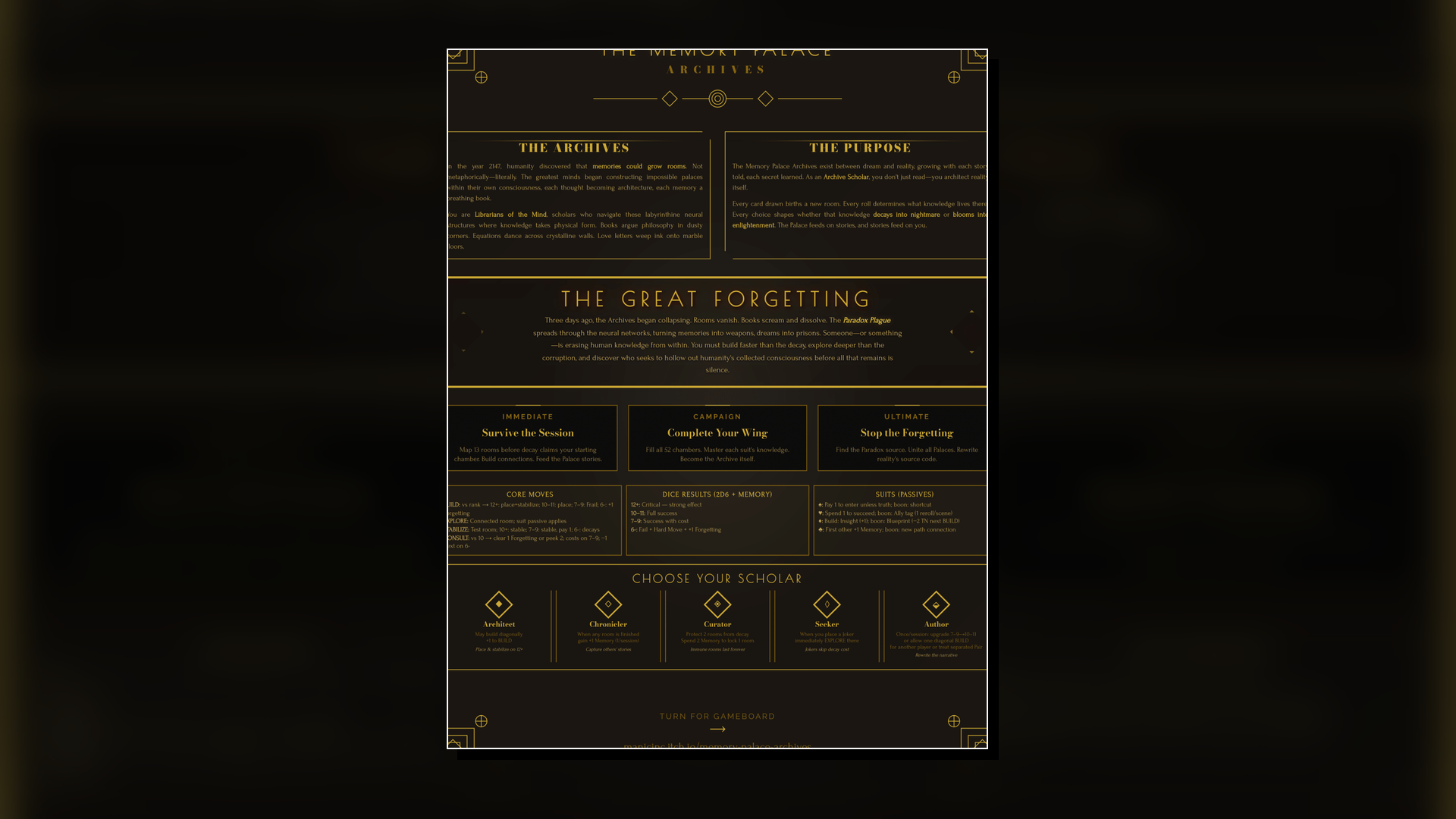
The Great Forgetting has begun. Neural palaces are collapsing. Build faster than the decay.
Scientific Foundation ↑
The Memory Palace Technique
Brain-imaging studies of high-performing memorizers show reliable activation in spatial and navigation networks (e.g., hippocampus, parahippocampal and retrosplenial cortices, medial parietal areas). Placing content in imagined space exploits these systems, improving encoding and recall.
Briefly learned virtual environments have been shown to work comparably to personally familiar places for the method of loci. This supports building new palace rooms at the table rather than relying solely on pre-existing mental maps.
Variable-Ratio Reinforcement
Variable-ratio schedules (the "maybe next" cadence) produce high engagement by distributing salient wins unpredictably.
In play:
- A standard deck yields 52 distinct draws
- Face cards and Jokers are rare, high-impact events
- Suits and combinations create emergent reward patterns
Core Mechanics & Psychology ↑
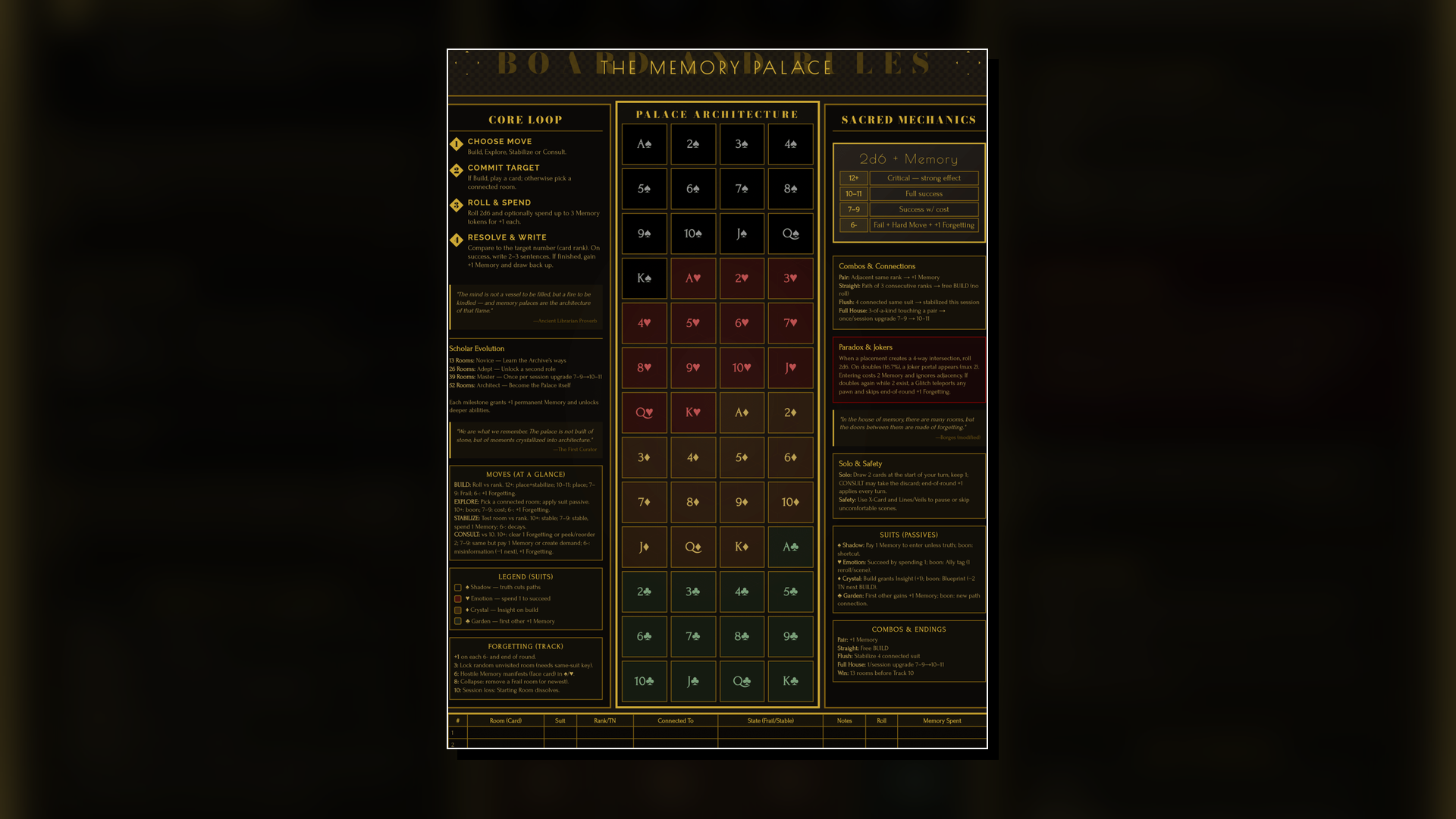
2d6 + Memory Tokens
Roll 2d6, then modify with Memory Tokens and situational effects.
Outcome bands (with exact odds):
- Failure (2–6): 15/36 ≈ 41.7%
- Partial (7–9): 15/36 ≈ 41.7%
- Full (10–11): 5/36 ≈ 13.9%
- Critical (12): 1/36 ≈ 2.8%
These distributions center on 7, aligning with flow theory by clustering most results near "partial," where meaningful choices (spend tokens? accept complications?) live.
Memory Tokens (cognitive load as resource)
- Start at 3 per player (models working memory capacity)
- Cap: 6 per player (i.e., you can gain up to +3 during play)
- Spend 1 to add +1 to a roll (declare after rolling)
- Tokens represent metacognitive strategy selection with real trade-offs
Collaborative Memory Dynamics
Human groups form collective memories, yet collaborative inhibition can reduce immediate group recall. The design mitigates this by:
- Assigning distinct roles to reduce retrieval disruption
- Encouraging transactive memory (who knows what, and where)
- Externalizing memory via written story fragments and maps
Transactive memory systems include what each member stores, how those stores interact, and the processes that update them.
Neuroscience of Memory Palaces ↑
Using loci links spatial navigation, visual imagery, narrative construction, and social encoding:, activating prefrontal and medial-temporal structures. The game actively engages these circuits by:
- Spatial navigation: physically placing cards on a map
- Visual imagery: detailing rooms' contents
- Narrative linking: stitching rooms with stories
- Social encoding: sharing and negotiating memory
Virtual environments are viable loci scaffolds, validating at-table creation of new wings and chambers.
Behavioral Design Principles ↑
Flow State Architecture
Grounded in Csikszentmihalyi's challenge—skill model:
- Clear goals: aim for 13 rooms per session
- Immediate feedback: every roll resolves on impact
- Challenge scaling: card values (A–K) pace difficulty
- Player control: Memory Tokens modulate difficulty on demand
Flow is sustained immersion—challenge, intrigue, focus, and victories in tight feedback loops.
The Zeigarnik Effect
People recall unfinished tasks better than finished ones. The design leverages:
- Decay system: unvisited rooms remain open loops
- Partial construction: leave some rooms unresolved
- Campaign tension: a 52-room macro-goal sustains momentum
Dopamine Scheduling
Layered reward timing:
- Micro: successful room placements (every 2–3 min)
- Medium: card combos (10–15 min)
- Major: completing suits (30–45 min)
- Ultimate: a full 52-room palace (5–10 sessions)
Play Guidelines ↑
Session Zero: Foundation Ritual
- Seed Memory: each player draws 3 cards
- Catastrophe Witness: describe first signs of forgetting
- Aesthetic Choice: Victorian / Brutalist / Organic / Crystalline
- First Room: build together to set tone and stakes
Scholar Roles & Mechanical Bonuses
The Architect
- Diagonal Builder: may build diagonally (in addition to orthogonally)
- +1 to BUILD: add +1 when making a BUILD move
The Chronicler
- The Scribe: when any room is finished (its essence is written), gain +1 Memory (once per session)
- Story Keeper: also triggers when others finish rooms
The Curator
- Guardian: each session, designate two rooms as protected (immune to decay)
- Locksmith: spend 2 Memory to lock one room permanently (cannot decay)
The Seeker
- Paradox Walker: when you place a Joker, immediately take a free EXPLORE there
- Portal Savvy: Jokers ignore adjacency and do not count toward decay when entered
The Author (choose one per session)
- Narrative Leverage:
- Treat a 7–9 as a 10–11, or
- Allow one diagonal BUILD for a non-Architect, or
- Declare a separated Pair counts as adjacent for combos
Solo Play: Meditative Architecture
- Use your Scholar's bonuses
- Journal between rooms
- Treat decay as a metaphor for personal forgetting
- Goal: a 13-room wing as a focused meditation
Group Play: Transactive Memory Formation
- Rotate Lead Librarian each round
- Build specialized domains across players
- Trade Memory Tokens as an information currency
- Late game: merge palaces via Joker bridges
Campaign Play: The Full Palace
- Track growth across sessions
- Introduce recurring book-NPCs
- Build toward confronting the Forgetting
- Ultimate layout: 52 rooms + 2 Paradox chambers
Designer's Notes ↑
Why "Growth" as Theme
- Literal: rooms physically grow from actions
- Neurological: new pathways form through practice
- Collaborative: transactive memory systems develop
- Narrative: stories expand and interconnect
Accessibility Considerations
- Cognitive: variable difficulty via token spending
- Physical: cards and graph paper over minis
- Economic: standard deck + dice only
- Social: fully solo-capable for anxious players
Research Applications
- Memory Enhancement: method of loci paired with spaced repetition can outperform top students; physical placement reinforces spatial encoding
- Collaborative Learning: former group members recall in more synchronized ways; role specialization counters collaborative inhibition
- Motivation Psychology: variable ratio reinforcement, Zeigarnik-driven continuity, and flow from tuned challenge
- Educational Potential: memory workshops, creative writing prompts, team building, therapeutic narrative reconstruction
Influences & Inspiration
- Borges – The Library of Babel
- Yates – The Art of Memory
- Morrison – The Invisibles
- Foer – Moonwalking with Einstein
Technical Specifications ↑
Required Materials
- 1 standard 52-card deck (+2 Jokers)
- 2d6 dice
- 15+ tokens per player
- Graph paper for mapping
- Shared journal for stories
Time Investment
- Quick: 30–45 min (~7 rooms)
- Standard: 60–90 min (~13 rooms)
- Epic: 2–3 hrs (26+ rooms)
- Campaign: 5–10 sessions (full palace)
Player Count
- Solo: full rules with automated decay
- 2–3: optimal for first sessions
- 4–5: maximum recommended
- 6+: split into parallel palaces
The Metacognitive Layer ↑
This game operates on multiple levels:
- Surface: fun card-based RPG
- Mechanical: probability & resource management
- Cognitive: active memory-palace construction
- Social: transactive memory system formation
- Narrative: collaborative story creation
- Metacognitive: players learn memory techniques while playing
Players build memory palaces in fiction while learning to build them in practice—technique becomes habit; habit becomes enhanced memory.
Future Research Directions ↑
- VR implementation: optimize rapid onboarding to loci skills
- Therapeutic applications: narrative reconstruction for trauma processing
- Educational variants: subject-specific decks (chemistry, history, languages)
- Competitive formats: memory-palace tournaments
- Digital companion: app for tracking multi-session palaces
Conclusion ↑
The Memory Palace Archives is Cognitive Training Entertainment: every mechanic is grounded in contemporary psychology and neuroscience to deliver play that is:
- Genuinely fun
- Scientifically informed
- Cognitively beneficial
- Socially enriching
- Narratively satisfying
Copyright ↑
© 2025 Manic.agency
Download
Click download now to get access to the following files:
Leave a comment
Log in with itch.io to leave a comment.